
- Hamzat says Central’s share may decline to 37% as North rises to 38%
Kwara Must Change (KMC), a prominent pro-democracy group in Kwara State, has projected that Kwara North Senatorial District could emerge as the largest voting bloc in the state by the 2027 general elections, potentially surpassing Kwara Central for the first time in the state’s political history.
In a statement issued by its Convener, Abdulrazaq Hamzat, the group noted that Kwara Central’s share of the statewide vote has declined steadily from 52 percent in 1999 to about 39 percent in 2023, representing a 13 percentage point reduction in its long-standing electoral dominance, historically driven by the urban population of Ilorin and surrounding areas.
By contrast, Kwara North’s share has increased from 24 percent in 1999 to 36 percent in 2023, marking a 12 percentage point growth over the same period.
Hamzat further observed that while Kwara North and Kwara South recorded similar vote shares in 1999, the North has since outpaced the South by more than 12 percentage points, underlining its steady emergence as a key electoral force in the state.
He noted that this growth is particularly significant given that Kwara North began as the smallest voting bloc among the three senatorial districts.
According to him, the district’s upward trajectory reflects improved grassroots organization, increased voter engagement, and rising political awareness across its largely rural and semi urban communities.
Kwara South, meanwhile, has maintained a relatively stable share, fluctuating between 24 and 26 percent, and continues to play a swing role in statewide elections.
The KMC Convener pointed out that the 2023 elections reduced the gap between Kwara Central and Kwara North to just four percentage points, the narrowest margin recorded in decades, signaling a significant shift in the state’s electoral balance.
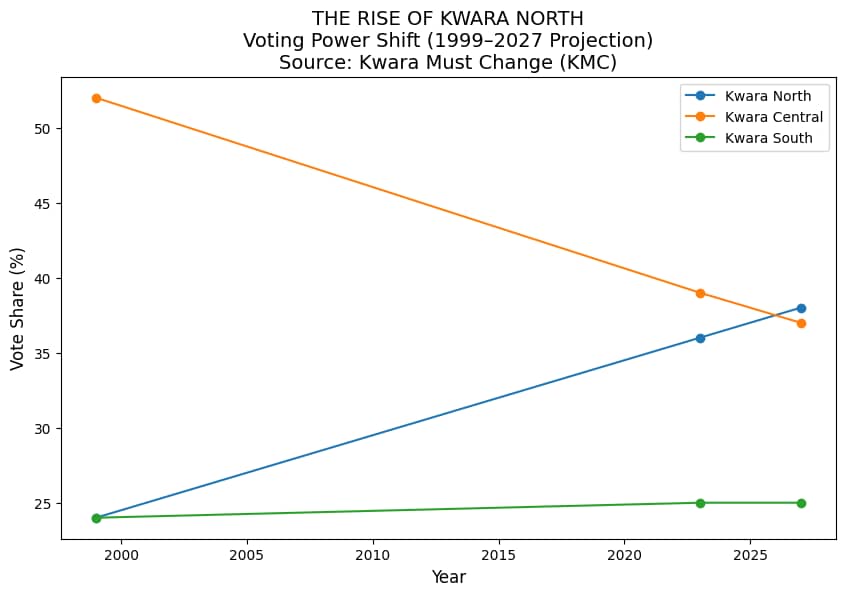
He attributed this trend to a combination of demographic changes, voter mobilization efforts, and evolving political behavior, which have enabled Kwara North to steadily expand its share, primarily drawing from Kwara Central and, to a lesser extent, Kwara South, particularly between 2015 and 2023.
Within this period, Kwara North is estimated to have gained approximately four percentage points from Central and about two points from South, consolidating its influence across its five local government areas, Baruten, Edu, Kaiama, Moro, and Patigi.
Looking ahead, KMC projects that Kwara North could secure between 38 and 39 percent of the total vote in 2027, while Kwara Central may decline to 37–38 percent, potentially marking a historic shift in the state’s political structure.
The group noted that even a modest continuation of the current growth rate, estimated at about two percentage points per election cycle, would be sufficient to overturn the existing margin.
According to Hamzat, such a development would reflect a broader transition from population driven dominance to performance driven mobilization, where organization, advocacy, and voter turnout play increasingly decisive roles.
He, however, cautioned that insecurity in parts of Kwara North could pose a challenge to voter mobilization if not effectively addressed.
“This projection should serve as a call to action for all senatorial districts to intensify voter sensitization, registration, and participation efforts,” Hamzat stated.
KMC, which played a notable role during the 2019 “Otoge” political movement and the 2023 election circle, said its projections are based on historical voting patterns, field engagement, and trend analysis.
The group concluded that the rising political momentum in Kwara North could significantly reshape the state’s electoral dynamics, with implications for future alignments, governance representation, and power distribution across the three senatorial districts.
End